
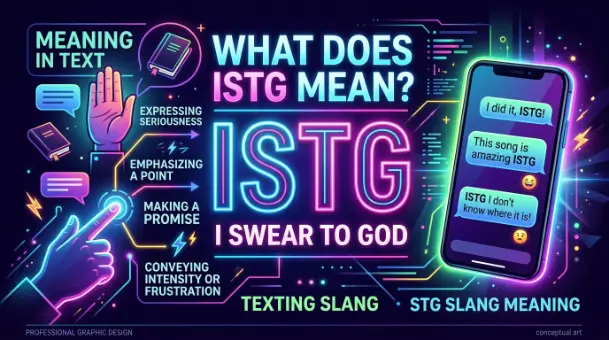
If someone texts you “ISTG,” they usually mean “I swear to God.”
In everyday texting and online conversations, ISTG is used to emphasize that someone is serious, telling the truth, frustrated, surprised, or strongly expressing an opinion. Depending on the situation, it can mean something like “I’m serious,” “I promise,” “I really mean it,” or “Believe me.”
For example:
“ISTG, I didn’t take your charger.”
This means:
“I swear to God, I didn’t take your charger.”
The important thing is that ISTG does not automatically mean the person is angry or making a literal religious oath. Its tone comes from the surrounding words and conversation.
What Does ISTG Meaning in Text?
ISTG stands for “I swear to God.”
It is an informal internet and texting initialism:
- I = I
- S = Swear
- T = To
- G = God
In modern online communication, people often use ISTG simply to add emotional emphasis to a statement.
So when someone writes:
“ISTG this is the best pizza ever.”
They are usually not making a formal oath. They are emphasizing how strongly they feel about the pizza.
The same abbreviation can communicate sincerity in one conversation and playful exaggeration in another. Context is what tells you which interpretation makes sense. Current explanations of ISTG consistently identify “I swear to God” as its standard meaning and describe emphasis, seriousness, frustration, and surprise as common uses.
ISTG Meaning in Text in Simple Words
If you want the shortest possible explanation:
ISTG = “I swear to God” = “I’m serious” or “I really mean it.”
Depending on the sentence, you could mentally replace ISTG with:
- I swear
- I promise
- Believe me
- I’m being serious
- I really mean this
- I can’t believe this
For example:
| Text | What ISTG is expressing |
|---|---|
| “ISTG I told you yesterday.” | I’m serious; I really told you. |
| “ISTG this movie is amazing.” | I really mean it; this movie is amazing. |
| “ISTG, stop doing that.” | I’m seriously annoyed. |
| “ISTG I saw him there.” | I strongly insist that I saw him. |
| “ISTG 😂 you are impossible.” | Playful frustration or exaggeration |
The literal phrase remains the same, but the emotional meaning changes with context.
How Is ISTG Meaning in Text Used in Texting?
ISTG is mainly used when someone wants to make a statement feel stronger.
1. To Insist Something Is True
One of the most straightforward uses is to emphasize honesty.
“ISTG I left my keys on the table.”
The person is essentially saying:
“I swear I left my keys on the table.”
Here, ISTG signals that the speaker wants to be believed.
2. To Show Frustration
ISTG can also introduce a complaint or an irritated reaction.
“ISTG, why does this keep happening?”
The speaker is expressing strong frustration.
Another example:
“ISTG if you delete my files again…”
This can sound like a warning, although the seriousness depends on the relationship and the rest of the conversation.
3. To Emphasize a Strong Opinion
Someone might use ISTG simply to make an opinion more emphatic.
“ISTG, that was the funniest video ever.”
Here, the speaker is probably being enthusiastic rather than angry.
4. To Express Surprise or Disbelief
ISTG can also appear when someone reacts strongly to something unexpected.
“ISTG, you actually did it!”
The phrase adds emotional intensity to the reaction.
5. For Playful or Dramatic Effect
Friends frequently use ISTG in an exaggerated way.
“ISTG this cat knows exactly when I’m trying to sleep 😂.”
The person is probably not making a serious oath. They are using ISTG to make a humorous complaint sound more dramatic.
This kind of playful usage is one reason you should not automatically interpret ISTG as anger.
Is ISTG Meaning in Text Always Serious?
No.
This is one of the most important things to understand about ISTG.
The abbreviation can be completely serious, mildly annoyed, excited, sarcastic, or humorous.
Compare these messages:
“ISTG I didn’t send that message.”
This probably sounds like a serious insistence.
Now compare:
“ISTG 😂 you make me laugh every day.”
This sounds friendly and playful.
And:
“ISTG, if you eat my fries again…”
This could be genuine irritation or an exaggerated joke between friends.
A Quick Tone Guide
| Example | Likely tone |
|---|---|
| “ISTG I didn’t do it.” | Serious / defensive |
| “ISTG, I’m telling the truth.” | Sincere |
| “ISTG this song is perfect.” | Excited |
| “ISTG, not again.” | Frustrated |
| “ISTG 😂 you’re crazy.” | Playful |
| “ISTG if you do that again…” | Warning / frustration |
Look at the rest of the message before deciding what the sender means.
What Does ISTG Meaning in Text on Social Media?
The basic meaning of ISTG does not normally change simply because it appears on a different platform.
You may encounter it in:
- Text messages
- Instagram DMs and comments
- TikTok comments
- Snapchat
- Discord
- Gaming chats
- Group chats
- Other casual online conversations
The context and tone can change, but the standard expansion remains “I swear to God.” Contemporary explanations of the term similarly describe its use across texting and social platforms as an informal way to add emphasis or emotional intensity.
ISTG on Snapchat
If someone sends:
“ISTG you have to watch this 😭”
they are probably emphasizing how strongly they recommend something.
If they write:
“ISTG, I told you already.”
they are probably frustrated or insisting that they already explained something.
So there is no special Snapchat-only definition you need to memorize.
ISTG on TikTok or Instagram
You may see comments such as:
“ISTG this is so accurate.”
or:
“ISTG I thought I was the only one.”
Here, ISTG generally adds emphasis or emotional intensity rather than functioning as a literal oath.
How Do You Know What ISTG Meaning in Text in a Specific Message?
When you’re unsure about the tone, use the context test.
Step 1: Read the words after ISTG
Ask what the person is actually saying.
“ISTG I didn’t do it.”
The surrounding sentence suggests honesty or defensiveness.
Step 2: Look for emotional clues
Words such as “again,” “why,” “stop,” or “can’t” can suggest frustration.
For example:
“ISTG, why are you doing this again?”
sounds much more irritated than:
“ISTG this is amazing!”
Step 3: Check emojis and punctuation
Emojis can completely change the feeling of a message.
“ISTG you’re unbelievable 😭😂”
may be playful.
“ISTG. Stop.”
looks much more serious.
Step 4: Consider your relationship with the sender
A close friend may use ISTG dramatically as a joke. A stranger or someone involved in an argument may use the same abbreviation more seriously.
Step 5: Read the conversation before and after it
Never interpret an abbreviation in isolation if the tone is unclear.
The message immediately before ISTG may explain whether the sender is joking, defending themselves, complaining, or expressing excitement.
Examples of ISTG Meaning in Text Conversations
Here are some natural examples.
Example 1: Insisting on the Truth
A: Did you take my headphones?
B: No, ISTG I didn’t.
Meaning: B is strongly insisting that they did not take the headphones.
Example 2: Frustration
A: The Wi-Fi stopped working again.
B: ISTG, this happens every day.
Meaning: B is expressing annoyance about the repeated problem.
Example 3: Excitement
A: Did you watch the new episode?
B: ISTG it was incredible!
Meaning: B strongly emphasizes how good they thought it was.
Example 4: Playful Exaggeration
A: I ate your last cookie.
B: ISTG I’m never sharing snacks with you again 😂
Meaning: This is probably playful rather than a serious threat.
Example 5: Serious Warning
A: I’ll be late again.
B: ISTG if you miss the bus this time, I’m leaving.
Meaning: The speaker sounds genuinely frustrated and is emphasizing the warning.
Is ISTG Meaning in Text Rude?
It can be, depending on how you use it.
The phrase itself is not automatically rude, but it can make a message sound stronger, more emotional, or more confrontational.
Compare:
“Please stop doing that.”
with:
“ISTG, stop doing that.”
The second message has considerably more emotional force.
With friends, this may be completely normal. During an argument, however, ISTG can make the message sound aggressive or irritated.
There is also a religious reference in the full phrase “I swear to God.” Some people may be comfortable with it, while others may prefer not to use expressions involving religious language.
Because of that, ISTG is best treated as casual, context-dependent language rather than a universally appropriate expression.
Can You Use ISTG Meaning in Text in Formal Writing?
Generally, no.
ISTG belongs to informal digital communication. It can fit naturally in a text to a friend, casual DM, or social-media conversation, but it would usually be inappropriate in:
- Professional emails
- Academic assignments
- Business reports
- Formal applications
- Official correspondence
- Professional customer communication
Instead of:
“ISTG, I sent the document yesterday.”
a professional message could say:
“I can confirm that I sent the document yesterday.”
The second version communicates the same basic idea without informal slang.
ISTG vs. “I Swear”
ISTG and “I swear” are closely related.
“I swear” is the normal phrase written out, while ISTG is its abbreviated internet form.
For example:
“I swear I didn’t take it.”
and:
“ISTG I didn’t take it.”
communicate essentially the same idea.
The difference is mainly style and context. ISTG feels more like casual texting or internet language.
ISTG vs. ONG
ONG commonly means “on God.”
It can serve a similar purpose to ISTG because both expressions can emphasize sincerity or strong agreement.
For example:
“ISTG, that was amazing.”
and:
“ONG, that was amazing.”
can both express strong emphasis.
However, they are not literally the same phrase. ISTG = “I swear to God,” while ONG = “on God.”
Don’t assume every abbreviation is interchangeable in every sentence; the speaker’s wording and tone still matter.
ISTG vs. OMG
These two abbreviations are easy to confuse because both contain G, but they serve different purposes.
- ISTG = I swear to God
- OMG = Oh my God
OMG is commonly used as a reaction to surprise, excitement, shock, or disbelief.
ISTG is more often used to emphasize a statement, insist on something, or express strong emotion.
For example:
“OMG, that’s unbelievable!”
is primarily a reaction.
“ISTG, that’s the best thing I’ve ever seen.”
is primarily an emphatic statement.
Is ISTG Meaning in Text an Acronym or an Initialism?
Technically, ISTG is better described as an initialism because the letters represent the initial letters of the words “I swear to God.”
It is generally pronounced by saying the individual letters rather than as a normal spoken word.
In everyday conversation, however, many people simply call it a texting acronym or internet abbreviation, and those terms are widely understood.
Where Did ISTG Meaning in Text Come From?
The full phrase “I swear to God” is much older than internet slang. It has long been used in English to emphasize truth, sincerity, or a strong statement.
The shortened form ISTG developed as part of internet and text-messaging language, where familiar phrases were compressed into initials.
There is evidence of ISTG being used online at least as far back as 2003, although an exact single “invention date” for internet slang is difficult to establish. Wiktionary’s entry documents an early 2003 online example and identifies ISTG as an initialism of “I swear to God.”
That distinction is important: an early documented example is not necessarily proof of the exact moment the abbreviation was created.
Common Ways People Use ISTG Meaning in Text
In everyday online conversations, ISTG commonly performs one of these functions:
- Insisting something is true
- Showing sincerity
- Emphasizing a promise
- Expressing frustration
- Showing strong excitement
- Expressing surprise or disbelief
- Adding dramatic or humorous emphasis
The abbreviation therefore works less like a word with several completely separate definitions and more like an emotional intensifier whose tone changes according to context.
How Should You Reply to ISTG Meaning in Text?
Your response depends on what the person is trying to communicate.
If they’re insisting they’re telling the truth
You could say:
“Okay, I believe you.”
If they’re frustrated
You could respond:
“Yeah, I get why you’re annoyed.”
If they’re joking
You can respond playfully:
“😂 Okay, okay!”
If they’re making a strong promise
You might simply acknowledge it:
“Alright, I trust you.”
You don’t need a special response just because someone used ISTG. Respond to the meaning of the whole message, not just the abbreviation.
Is ISTG the Same as “I Promise”?
Not exactly.
“I promise” directly expresses a promise.
“I swear to God” can express a promise, but it can also be used simply to emphasize that a statement is true or to show strong emotion.
For example:
“ISTG I saw a fox outside.”
This is more naturally understood as “I swear I saw a fox outside” than as a formal promise.
So “I promise” can be a possible interpretation in some contexts, but it is not the literal definition of ISTG.
What Does Lowercase “istg” Mean?
There is generally no difference in meaning between:
ISTG
and:
istg
The uppercase version and lowercase version represent the same abbreviation.
Lowercase text is common in casual messaging because people often type informal conversations without capitalization.
Similarly:
- ISTG
- istg
- Istg
can all refer to “I swear to God.”
The capitalization usually affects style, not meaning.
FAQs:
What does ISTG mean in text?
ISTG usually means “I swear to God.” It is an informal texting abbreviation used to emphasize sincerity, seriousness, frustration, excitement, or another strong emotion.
What does ISTG stand for?
ISTG stands for “I swear to God.” The letters come from the first letters of the four words.
Does ISTG mean “I promise”?
Sometimes it can communicate a similar idea, especially when someone is insisting that something is true. However, its literal expansion is “I swear to God.”
Is ISTG a bad word?
ISTG is not a profanity by itself, but the full phrase contains a religious reference that some people may consider inappropriate or uncomfortable in certain settings.
Is ISTG rude?
Not necessarily. It can be friendly, funny, sincere, frustrated, or confrontational. The surrounding conversation determines the tone.
Can I use ISTG with my friends?
Yes. ISTG is primarily informal, so it can fit naturally in casual conversations with friends when it matches the tone.
Is ISTG appropriate for work emails?
Usually not. It is internet slang and can sound too casual or emotional for professional communication.
Does ISTG mean something different on TikTok or Snapchat?
Usually, no. The standard meaning remains “I swear to God.” What changes is the tone and context in which someone uses it.
Is ISTG the same as ONG?
They are similar in function because both can emphasize sincerity or a strong statement, but they are different expressions. ISTG means “I swear to God,” while ONG commonly means “on God.”
How do I know whether ISTG is serious or joking?
Look at the surrounding words, punctuation, emojis, and previous messages. “ISTG I didn’t do it” is likely serious, while “ISTG 😂 you’re hilarious” is probably playful.
Conclusion
ISTG means “I swear to God” in text and online slang.
People use it to add weight to what they are saying. It can communicate sincerity, insistence, frustration, excitement, surprise, or playful exaggeration.
The key is not to treat ISTG as automatically angry or completely serious. A message like “ISTG I didn’t do it” is different from “ISTG 😂 this is hilarious.”
So, when you see ISTG, start with “I swear to God,” then look at the rest of the conversation to understand the speaker’s actual tone.
That context is what turns four letters into the right meaning.

Hi, I’m Alex Martin, the voice behind punscore.com, where words meet curiosity, clarity, and a little fun.
I love exploring the meaning, usage, and fascinating stories behind words and phrases that people encounter every day.
My goal is simple: make confusing words easier, interesting topics clearer, and every answer worth reading.
At Pun Score, I create reader-friendly content that cuts through the confusion and gets straight to what matters.
I believe great writing doesn’t need to be complicated—it needs to be useful, natural, and memorable.
Whether you’re here to understand a tricky phrase, discover a word’s meaning, or simply learn something new, I’m glad you’re here.
Welcome to punscore.com—let’s make words make sense.