
If you saw someone write “ion know,” “ion care,” or “ion wanna go”, they probably are not talking about chemistry. In casual texting and online slang, “ion” usually means “I don’t.” It is an informal, speech-based spelling that reflects how “I don’t” can sound when said quickly.
For example:
- “ion know” = “I don’t know”
- “ion care” = “I don’t care”
- “ion want that” = “I don’t want that”
- “ion think so” = “I don’t think so”
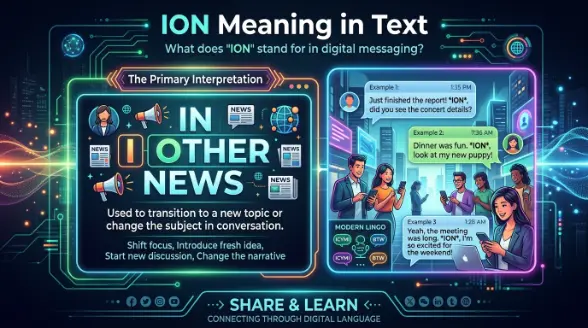
However, ION can have another meaning: “In Other News.” That version is used to shift from one topic to another. The surrounding sentence is usually enough to tell which meaning is intended.
What Does ION Meaning in Text?
In most casual text conversations, ion = “I don’t.”
It is better understood as a phonetic or speech-based spelling than as a conventional acronym. Unlike “LOL” or “BRB,” the letters in ion do not represent the first letters of “I don’t.” Instead, the spelling reflects a casual pronunciation of the phrase.
Quick examples
| Text | Standard English |
|---|---|
| ion know | I don’t know |
| ion care | I don’t care |
| ion want it | I don’t want it |
| ion like that | I don’t like that |
| ion remember | I don’t remember |
| ion think so | I don’t think so |
So if someone messages:
“Ion know what happened.”
They simply mean:
“I don’t know what happened.”
Why Do People Write “ION” Instead of “I Don’t”?
The spelling comes from casual spoken language. When people say “I don’t” quickly, the consonant sounds can be reduced or blended, producing a pronunciation that can be represented in writing as ion.
Dictionary.com documents ion meaning “I don’t” as an internet-writing usage emerging in the 2000s and also notes a separate use of ION meaning “in other news.”
The written form is therefore not necessarily a typo. It is often an intentional way to make a message sound more conversational, relaxed, or speech-like.
Is ION Meaning in Text an Acronym?
Usually, no.
When someone writes:
“ion know”
they normally mean:
“I don’t know.”
It is a stylized spelling rather than a traditional initialism.
However, ION can be an acronym for “In Other News.” In that usage, it works as a transition into another subject.
This distinction is important because the same three letters can represent different things.
ION Meaning in Text: “I Don’t” vs. “In Other News”
Context is the easiest way to tell the difference.
| Example | Likely meaning |
|---|---|
| “ion know what to say” | I don’t |
| “ion want to go” | I don’t |
| “ion care anymore” | I don’t |
| “ION, did you see the new trailer?” | In Other News |
| “ION, something funny happened today.” | In Other News |
A useful clue is what comes immediately after ION.
When ion is followed by a verb or verb phrase, such as know, care, want, like, think, it is generally the slang spelling of “I don’t.”
When ION introduces a completely new thought or topic, it can mean “In Other News.”
Don’t rely only on capitalization
Capital letters can provide a clue, but they are not a reliable rule.
Someone may write:
- ion know
- Ion know
- ION KNOW
and still mean “I don’t know.”
Likewise, “In Other News” may appear as ION, ion, or with other capitalization depending on the writer. Context and sentence structure matter more than capitalization.
Examples of ION Meaning in Text
Here are some natural examples:
Example 1
Friend: Are you coming to the party?
You: Ion know yet.
Meaning: I don’t know yet.
Example 2
Friend: Do you care what they say?
You: Ion care.
Meaning: I don’t care.
Example 3
Friend: You should try that restaurant.
You: Ion like seafood.
Meaning: I don’t like seafood.
Example 4
Friend: Are you buying those shoes?
You: Nah, ion want them anymore.
Meaning: No, I don’t want them anymore.
“That movie was surprisingly good. ION, did you hear about the sequel?”
Here, ION means “In Other News” because the writer is deliberately changing the subject.
How Does ION Sound in a Message?
When used as “I don’t,” ion gives a message a distinctly casual and conversational feel.
Compare:
“I don’t know what happened.”
with:
“Ion know what happened.”
The basic meaning is the same, but the second version sounds more like informal online conversation.
The spelling can also make a message feel more relaxed, humorous, emphatic, or connected to a particular online speech style. The exact tone still depends on the rest of the message.
Is ION Meaning in Text Rude?
Not by itself.
“Ion” is simply an informal way of expressing “I don’t.” Whether a message sounds rude depends much more on the words surrounding it.
For example:
- “Ion know, sorry 😭” likely casual or apologetic
- “Ion think so lol” casual disagreement
- “Ion care.” can sound dismissive depending on the situation
The phrase “I don’t care” can already sound blunt in standard English, and changing it to “ion care” does not automatically make it friendlier.
So don’t interpret ion itself as an insult or rude expression.
Where Is ION Meaning in Text Used?
You may encounter ion in informal digital communication, including:
- Text messages
- Group chats
- Social media comments
- Direct messages
- Memes
- Online communities
- Casual posts
It is particularly associated with informal internet language and speech-based writing. Dictionary.com has documented the “I don’t” usage in internet writing, while slang references describe its use in casual online chats.
That does not mean every appearance of “ion” has the slang meaning. A chemistry discussion, for example, may simply be using the ordinary scientific word.
What Does ION Meaning in Text on TikTok?
On TikTok and similar social platforms, ion commonly means “I don’t” when it appears as part of a phrase such as:
- “ion know”
- “ion care”
- “ion want that”
- “ion think so”
You may also encounter ION = “In Other News”, particularly when the writer uses it to introduce a new subject.
The important thing is to read the whole sentence rather than interpreting the three letters in isolation.
What Does ION Meaning in Text on Snapchat?
In a casual Snapchat conversation, ion usually means “I don’t.”
For example:
“ion wanna go 😭”
means:
“I don’t want to go.”
Likewise:
“ion know what you’re talking about”
means:
“I don’t know what you’re talking about.”
Because Snapchat conversations are generally informal, the speech-based slang interpretation can be especially natural in this setting.
Can ION Mean “I Don’t Know”?
Yes, but there is an important distinction.
ION itself usually means “I don’t,” not specifically “I don’t know.”
For example:
- ion + know = I don’t know
- ion + care = I don’t care
- ion + want = I don’t want
- ion + think = I don’t think
So if someone asks, “What does ion mean?”, the most precise answer is “I don’t.”
The words following it complete the meaning.
Is “ION” the Same as “IDK”?
No.
Both can appear in informal conversations, but they work differently.
| Slang | Meaning | Example |
|---|---|---|
| ION | I don’t | “ion want it” |
| IDK | I don’t know | “idk what happened” |
| IDC | I don’t care | “idc anymore” |
| IMO | In my opinion | “imo that’s better” |
ION is a speech-based spelling of “I don’t,” while IDK and IDC are initialisms formed from the words in their phrases.
Is ION Meaning in Text Formal English?
No.
When ion means “I don’t,” it is informal slang and is generally unsuitable for formal writing.
Avoid it in:
- School assignments
- Academic papers
- Business emails
- Job applications
- Professional reports
- Formal letters
For those situations, write “I don’t” instead.
In a casual message to a friend, however, using ion can be perfectly understandable.
What About the Scientific Word “Ion”?
There is also a completely different word ion in science.
In chemistry, an ion is an atom or group of atoms carrying an electrical charge. The scientific meaning has nothing to do with the texting slang.
For example:
“Sodium can form a positively charged ion.”
Here, ion is the scientific term.
Compare that with:
“Ion know what happened.”
Here, ion is texting slang for “I don’t.”
The surrounding context makes the distinction clear.
How to Figure Out What ION Meaning in Text
If you are unsure, use this simple three-step check:
1. Look at the words after “ion”
If you see:
ion know → likely I don’t know
ion care → likely I don’t care
ion want → likely I don’t want
This is the strongest clue in ordinary texting.
2. Check whether the topic suddenly changes
If someone writes:
“The game was fun. ION, did you see Sarah yesterday?”
ION likely means “In Other News” because the writer is moving to a different topic.
3. Consider the subject of the conversation
If the conversation is about:
- Chemistry → ion may mean a charged particle.
- Casual texting → ion may mean “I don’t.”
- A topic transition → ION may mean “In Other News.”
Context is more useful than capitalization alone.
Can You Use ION Meaning in Text Yourself?
Yes, if the conversation is informal and the other person understands internet slang.
For example:
Friend: You wanna watch another episode?
You: Ion think I can stay up that late 😂
That works naturally in a casual chat.
But if you are writing to a teacher, employer, client, or professional contact, use “I don’t” instead.
FAQs:
What does ion mean in text?
In casual texting, ion usually means “I don’t.” It is a speech-based slang spelling commonly used in informal online conversations.
What does ion mean on TikTok?
On TikTok, ion commonly means “I don’t” when it appears before a verb, such as “ion know” or “ion care.” It can also mean “In Other News” when used as a topic transition.
What does ion mean on Snapchat?
On Snapchat, ion commonly represents “I don’t” in informal messages. For example, “ion wanna go” means “I don’t want to go.”
Is ion short for “I don’t”?
Yes. In slang usage, ion is a phonetic or speech-based spelling of “I don’t.” It is not normally an acronym made from the initials of those words.
Does ION also mean “In Other News”?
Yes. ION can stand for “In Other News” and can be used to introduce a new or unrelated topic.
Is ion a real word?
Yes, but it has multiple uses. Ion is a standard scientific word for a charged atom or group of atoms, while ion meaning “I don’t” is informal internet slang.
Is ion rude?
Not inherently. It is simply informal slang. The tone can be friendly, neutral, dismissive, or blunt depending on the complete message.
Should I use ion in formal writing?
No. If you are writing something formal or professional, use “I don’t” rather than the slang spelling “ion.”
Conclusion
When you see “ion” in a casual text, the most likely meaning is “I don’t.” Phrases such as “ion know,” “ion care,” and “ion want that” are informal ways of writing “I don’t know,” “I don’t care,” and “I don’t want that.”
But context still matters. ION can also mean “In Other News,” especially when it appears as a transition between unrelated topics. And in a science-related conversation, ion may simply have its normal chemistry meaning.
The easiest rule is simple: look at the words around “ion.” If it comes before a verb, “I don’t” is usually the intended meaning; if it introduces a new topic, “In Other News” may be intended.

Hi, I’m Alex Martin, the voice behind punscore.com, where words meet curiosity, clarity, and a little fun.
I love exploring the meaning, usage, and fascinating stories behind words and phrases that people encounter every day.
My goal is simple: make confusing words easier, interesting topics clearer, and every answer worth reading.
At Pun Score, I create reader-friendly content that cuts through the confusion and gets straight to what matters.
I believe great writing doesn’t need to be complicated—it needs to be useful, natural, and memorable.
Whether you’re here to understand a tricky phrase, discover a word’s meaning, or simply learn something new, I’m glad you’re here.
Welcome to punscore.com—let’s make words make sense.